
Broward County’s Sheriff’s Office, long shadowed by a history of controversy, financial scrutiny, and mismanagement, rightly faces yet another chapter of concern over its budget and operations. As sheriffs and departments submit their budgets for the coming fiscal year, alarm bells are ringing over the outlandish requests by Broward’s Sheriff, Gregory Tony. Now that affordability is the #1 issue in South Florida, with economic pressures on homeowners greater than ever, it is imperative that Broward citizens understand precisely how their Sheriff’s Office is funded, whether they are truly getting the most value out of their dollar, and what better options are available.
Ballooning Budgets
Sheriff Tony is also requesting $429 million for “capital projects”—on top of the 10% increase in funding over last year. Out of this $429 million, $180 million is earmarked for “BSO HQ improvements”; $89 million set aside for a new 911 dispatch center; $42 million for a larger evidence and vehicle warehouse; and $39 million to rebuild the County Stockade. Whether they are necessary improvements or not is beyond the point—this is a major financial burden for the citizens of Broward County to have dumped on their shoulders, especially considering how the Broward Sheriff’s Office is funded.
Broward’s Controversial Funding Mechanism
Unlike many other police departments and sheriff’s offices, which are allocated funding out of the county’s “general fund,” Broward’s Sheriff’s Office is funded in a more direct way—by the property taxes of Broward’s citizens. About one-third of the BSO is funded by city contracts with twelve cities—providing about $500 million to the budget. The vast majority of the remaining two-thirds, however, is funded by property taxes. In fact, over half of all property taxes paid by Broward citizens goes directly to the Sheriff’s Office [~55% of county funds]. Meanwhile, those paying for it don’t seem to have any say in where the money goes, how it is spent, or anything of the sort.
If the money was being well-spent, there might not be as much of an issue for most people—except it is very clear that the money is not, in fact, being well-spent. Several cities have expressed dissatisfaction with the services of the BSO; some, like Deerfield Beach, have disputed contract increases. Weston has reportedly hired a financial expert, tasked with running the numbers to see if it should just create its own sheriff’s office or police force. They have also requested a “revised agreement” with BSO—so even if they do not ditch Broward Sheriff’s Office altogether, they are so unhappy with their service that they want to change the agreement entirely. This is not how a healthy sheriff’s office operates or is treated by its constituents. However, to some degree this is old news—malfeasance within the BSO stretches back decades.
A Tattered History
Right now, in 2025, roughly 40% of Broward’s wildly inflated budget is allocated to the management of jails. Yet despite this, there are continual staff shortages, accusations of mistreatment, underpayment, and overall chaos behind the scenes; 21 prisoners have died in the past four years because of BSO’s inability—or refusal—to spend their money wisely and make sure the jails are well-run and fully-staffed. On top of this, the high-profile “Tamarac triple murder” has been linked to “deputy lapses” and understaffing/undertraining, prompting the NAACP to demand a federal civil rights investigation. Unfortunately for those in Broward, this seems to be a pattern for their sheriff’s office.
During COVID, 17 BSO employees were charged with wire fraud for defrauding the COVID-19 PPP relief program, collecting approximately $500,000 before being caught. Another BSO civilian employee was charged with grand theft and other serious offenses related to fraudulent tax returns. While these employees did eventually get caught and served with proportional/legal punishment, it speaks to a work-culture of financial deception, where employees are clearly not vetted enough to ensure they will do their job properly. The only alternative is that these people start off honest and then only after exposure to the culture within the BSO, “become” deceptive and fraudulent. This, alone, is enough to prompt a serious investigation into the BSO’s hiring practices and work culture, but Broward—both its Sheriff’s Office and its government—have a history of misusing public funds.
Broward – A Multi-tent Circus
Broward County as a whole, not just the BSO, has a history of misusing public funds stretching back to the 1950s and 1960s. While it would be foolish to link events 70 years ago to events today, it does, to some degree, speak to the culture of Broward public life—that deception, fraud, and exploitation are the currency of the kingdom, or so it seems from the outside.
- In 2017, a “significant” fraud scheme was uncovered, involving $2.4 million in stolen funds from tax-deed surplus distributions. A county audit identified $800k in “questionable payments” after an initial BSO investigation led to charges against a tax office employee.
- In 2013, the Broward Inspector General found “gross mismanagement” of millions in public funds by Hallandale Beach officials, including the failure to establish a required CRA trust fund, leading to the co-mingling of CRA and city funds.
- Even as recently as this year, 2025, an Inspector General report accused the county’s first ever elected tax collector of campaign violations, labeled as “misconduct” but not a corrupt misuse of her position.
- Representative Sheila Cherfilus-McCormick of Florida’s 20th District (mostly Broward County) is currently under a US House of Representatives ethics investigation for multiple campaign finance violations that may have allowed her to win her campaign in 2021.
In this environment, is it any surprise that Broward’s Sheriff’s Office feels like they have the justification to misuse funds and demand outlandish budgets for themselves? There are many more instances of fraud and misconduct; these are just representative examples. And while it is not directly tied to the misuse of public funds, Broward County has a significant problem with property fraud; scammers forge deeds to steal properties, often targeting vulnerable populations like the elderly and infirm. Given that Broward’s Sheriff’s Office is funded directly by property taxes, this specific kind of fraud cuts into potential funding for said office—funding that could be used to rid Broward of these problems.
However, nothing exists in a vacuum; is this a unique case, or is it common for sheriff’s offices in Florida to misuse their funds? A comparative analysis of Broward vs. some other large, well-funded sheriff’s offices in Florida can shed light on the situation.
BSO vs HCSO vs PCSO
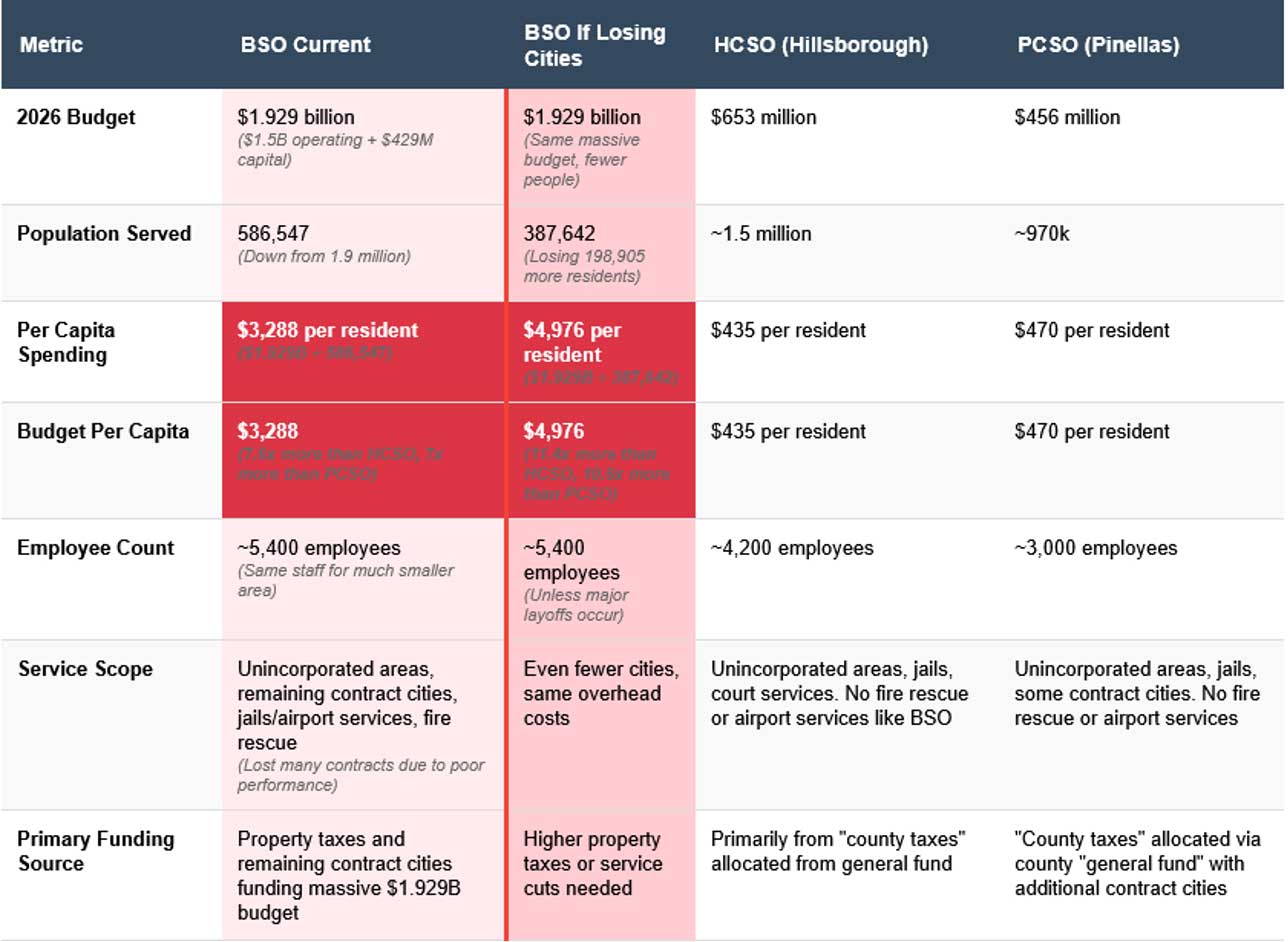
For comparative purposes, Hillsborough and Pinellas County Sheriff’s offices were looked at next to Broward county, and the results are not shocking to anyone paying moderate attention.
Key Observations
Budget Analysis
- BSO has by far the largest budget at nearly $2 billion total
- BSOspends significantly more per capita – $3,288 total compared to HCSO ($431) and PCSO ($501)
- BSO’s total per capita spending is 7.6x higher than HCSO and 7x higher than PCSO
- BSO’s budget is over 3x larger than HCSO despite serving only ~400k more residents
Service Differences
- BSO provides the most comprehensive services including fire rescue and airport services
- HCSO and PCSO focus primarily on traditional law enforcement and jail operations
- BSO contracts with 12 cities vs fewer contract arrangements for the other agencies
Funding Structure
- BSO has a more diversified funding model with significant contract city revenue
- HCSO and PCSO rely more heavily on county general fund allocations
- BSO’s property tax component represents the largest single funding source
Operational Scale
- BSO operates at a significantly larger scale in terms of budget, employees, and service scope.
- The per capita spending differential suggests either higher service levels or less efficient resource allocation at BSO.
- PCSOserves the smallest population but maintains competitive per capita spending
What it all means
Broward County and its Sheriff’s Office allocate their resources in the most inefficient ways. While the BSO budget includes fire rescue, and the other budgets do not, very quick math shows this is irrelevant.
Broward’s per capita spending is almost twice that of the other sheriff’s offices shown above, and the fact that they pay for fire rescue (around $200 million of the budget [adjusted for verification]) does not account for the discrepancy. It does not double the per capita spending, not by a long shot.
Citizens of Broward County need to demand more transparency—and meaningful reform—from the Broward Sheriff’s Office, or even come up with a better solution than the BSO.
With the BSO largely funded directly by property taxes—in an area already burdened with wildly inflated property taxes since 2018—every failure of the Sheriff’s Office is a direct misuse of the hard-earned money of its constituents. This is nothing short of an attack on the very people they purport to be defending—and it needs to change.