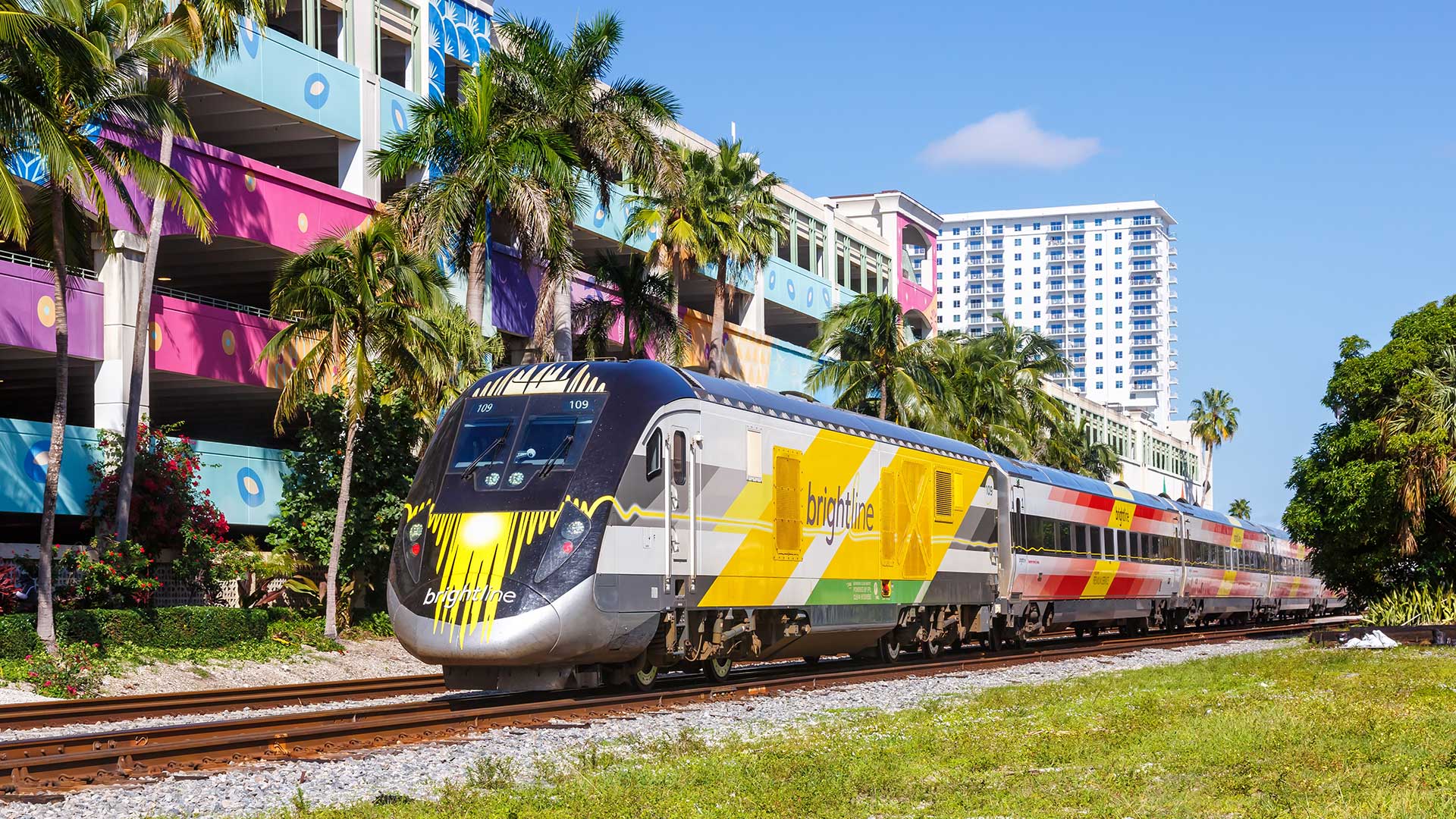
Brightline, the high-speed rail connecting Miami to Orlando, has been promoted as a modern solution to Florida’s transportation challenges. Launched in 2018 with service between Miami, Fort Lauderdale, and West Palm Beach, and extended to Orlando in 2023, it was intended to reduce highway congestion and offer efficient travel. However, the reality has been far different: persistent cost overruns, underwhelming ridership, and heavy reliance on public funds that benefit private interests more than the public. This private venture, owned by Fortress Investment Group, has drawn sharp criticism for being a massive waste of taxpayer money. Democrat elected officials at the federal, state and local levels have played a key role in enabling this, pushing subsidies and support despite mounting evidence of failure. What a sustainable future looks like for Brightline is a critical question that elected officials and the company need to determine.
The funding history of Brightline reveals a pattern of ambitious pledges followed by disappointing results. Initially pitched as largely privately funded, the project has absorbed billions in public support, including tax-exempt bonds and grants. Costs for the Miami-Orlando line escalated from around $3 billion to over $6 billion by 2023, with total estimates now nearing $13 billion when including expansions. In 2024, Brightline reported $549 million in losses, even as revenue grew. By mid-2025, financial pressures intensified: the company refinanced $985 million in debt at a 14.89% yield, one of the highest for such bonds, after failing to pay interest on $1.2 billion in obligations. Bond ratings plummeted, with Fitch downgrading to B (deep into junk territory) due to weaker ridership, lower fares, and high costs. S&P and KBRA followed with similar downgrades, citing liquidity strains and underperformance. Brightline bonds lost $870 million in market value in July 2025 alone. These issues highlight how initial promises of financial viability have unraveled, leaving investors and taxpayers exposed.
Ridership projections represent some of the most glaring broken promises. Early on Brightline executives forecasted 8 million passengers by 2026, and $700 million in revenue. By 2024, forecasts were cut to 5.5 million, or as low as 4 million in pessimistic scenarios. Actual figures were even worse: December 2024 saw 162,445 long-distance riders (up 40% year-over-year but still modest), and July 2025 totaled 255,472 overall, flat from June. For 2025, projections now sit at 3.1 million riders—53% below prior estimates. Q2 2025 ridership reached 754,545, with long-haul up 18% to 464,934, but revenue dipped to $51.3 million, but a small fraction of what is needed to service the mountain of debt, and build out the service. South Florida saw a 7% increase in June to over 84,000, but overall numbers remain far from justifying the investment. Critics, including Treasure Coast residents, warned in 2018 that premium pricing would deter everyday users, a prediction that’s proven accurate.
The Northeast Corridor commuter project exemplifies these failures on a local scale. Aimed at adding Tri-Rail-style stops from Miami to Aventura, it was touted as a way to boost urban connectivity for areas like Wynwood and Little Haiti. In summer 2024, the Florida Department of Transportation offered $200 million in state funding as a match for federal grants. Democrat-led county officials, such as Commissioner Eileen Higgins, championed it as essential for growth. The Biden administration’s U.S. Department of Transportation approved $389 million for the 2026 budget, with Miami-Dade committing $200 million locally, eyeing a $789 million pool for the $927 million project.
Those commitments collapsed in June 2025. The Republican-led Florida Legislature redirected real estate “doc” stamp taxes—previously allocating $40-50 million annually for rail—to general funds for tax cuts, erasing the state match. They also eliminated a 2% commercial lease sales tax, cutting $27 million yearly from Miami-Dade’s transportation revenue (an 8% hit). Governor Ron DeSantis signed the budget on June 30, 2025. Commissioner Higgins called it a “mistake” and pushed for fixes, but advocates had little time to respond. House Speaker Danny Perez dismissed backlash as “political,” vaguely promising alternatives later. Without the state funds, the federal portion is at risk, stalling progress.
Tri-Rail collateral damage
The subsidy cuts have broader implications, threatening the very existence of Tri-Rail, which interconnects with Brightline at MiamiCentral station and shares synergies with the proposed commuter expansions. As of September 2025, Tri-Rail faces a potential shutdown by June 2027 if the Florida Department of Transportation (FDOT) does not restore its dramatic subsidy reduction—from up to $62 million annually (with a minimum of $42 million) to just $15 million starting in the 2025-26 fiscal year. This $27 million to $47 million cut has forced Tri-Rail, operating on a $150 million annual budget, to dip into dwindling reserves until mid-2027, after which Palm Beach, Broward, and Miami-Dade counties would need to triple their contributions from about $4 million each to $10 million to keep it afloat. Executive Director David Dech has been lobbying officials, but reactions, particularly from Palm Beach County commissioners, indicate little appetite for increased local funding.
To mitigate the crisis, Tri-Rail is exploring limited options, including fare increases that Dech admits “won’t bridge this gap” and could alienate riders; service cuts, such as eliminating late-night trains (already done) or subsidized ride-share programs like taxis, airport shuttles, and emergency buses; delaying capital projects like a new maintenance facility near West Palm Beach or replacing 35% of its rolling stock; and selling underutilized properties in Fort Lauderdale and Hialeah, though zoning and size constraints limit their value. As a last resort, legal action against FDOT for breaching its $42 million minimum commitment is on the table, though Dech prefers collaborative solutions. These developments underscore how state-level decisions are unraveling interconnected rail initiatives, including those tied to Brightline, further eroding promises of enhanced public transit in South Florida.
Recent developments add insult: In August 2025, FEC Railway sued Brightline over the expansion, complicating matters further. Nearly half a billion in taxpayer dollars have already gone to Brightline-related projects, yet results lag. This pattern of funding evaporation raises serious questions about accountability, especially given the project’s ties to developer interests.
Safety concerns compound the financial woes. Brightline holds the dubious title of America’s deadliest rail per mile, with 182 fatalities since 2017—one every 13 days. Of these, 41% were suicides, but the rest stem from trespassing and grade-crossing incidents, made possible by little protective fencing around the tracks. In 2025 alone, the Treasure Coast saw two deaths by June. Critics accuse Brightline of blaming victims rather than investing in safeguards, even soliciting public funds for upgrades. U.S. Transportation Secretary Pete Buttigieg called the toll “unconscionable,” yet federal support continues .
Democrats bear significant responsibility for propping up this troubled operation. Florida Democrats have vocally backed Brightline workers’ unionization, framing it as a labor victory while overlooking broader issues. The Biden administration provided $3 billion for Brightline West (the Vegas extension) via the Bipartisan Infrastructure Law, part of a $12 billion project facing similar skepticism. Locally, figures like Higgins led lobbying efforts in D.C. in April 2025, seeking bipartisan aid despite evident flaws. Florida Democrats have been quietly supportive overall, prioritizing “green” infrastructure over fiscal prudence. Even as feds sided with unions against Brightline in a 2025 dispute, the underlying subsidies persist. Critics argue this enables a system where public money flows to private profits, with little return for residents/taxpayers.
The impacts are real and burdensome. Promised economic boosts for neighborhoods remain unrealized, as funds redirect to tax breaks for those who pay them. Miami-Dade’s transit budget suffers, affecting buses and roads. Brightline’s premium model excludes average commuters, ensuring low usage and perpetual losses. With over $5 billion in debt and legal battles mounting, the project’s sustainability is in doubt. Brightline’s legacy is one of hype unmet by reality: budgets blown, riders absent, and promises not delivered. Democrats’ enthusiasm has fueled this public transit fiasco, channeling billions into an overpriced, underutilized, and unsafe service. Florida needs genuine infrastructure solutions, not this costly distraction. Without real oversight and effective restructuring, it risks remaining a symbol of misplaced priorities and a drain on public finances.